
The U.S. has its own open exchange network for B2B e-invoicing, and why parts of the industry already call it Peppol’s American counterpart
The United States still has no federal e-invoicing mandate for private-sector B2B transactions, which is largely why “compliance” doesn’t carry the same weight in a U.S. AP department that it does in Paris or Riyadh. But the regulatory quiet has masked something else: the U.S. has its own operating open exchange network for B2B document exchange, built by industry rather than legislated by the government. It’s called the Digital Business Networks Alliance, or DBNAlliance, and its member roster already includes Chevron, ConocoPhillips, Microsoft, Halliburton, and Weatherford, alongside a growing list of certified service providers.
Because the DBNAlliance’s architecture closely mirrors Peppol’s, the network underpinning most of the world’s e-invoicing mandates, parts of the industry have started describing it in exactly those terms. DDD Invoices, an e-invoicing platform, calls the DBNAlliance “the North American counterpart to the European Peppol network.” The Invoicing Hub, a publication that tracks e-invoicing developments globally, puts it more bluntly: “To many, DBNAlliance may simply appear as ‘another Peppol network.’”
Want to learn more about Peppol? Watch this webinar where I’m discussing the 7 crucial things to learn about Peppol.
How the DBNAlliance Works
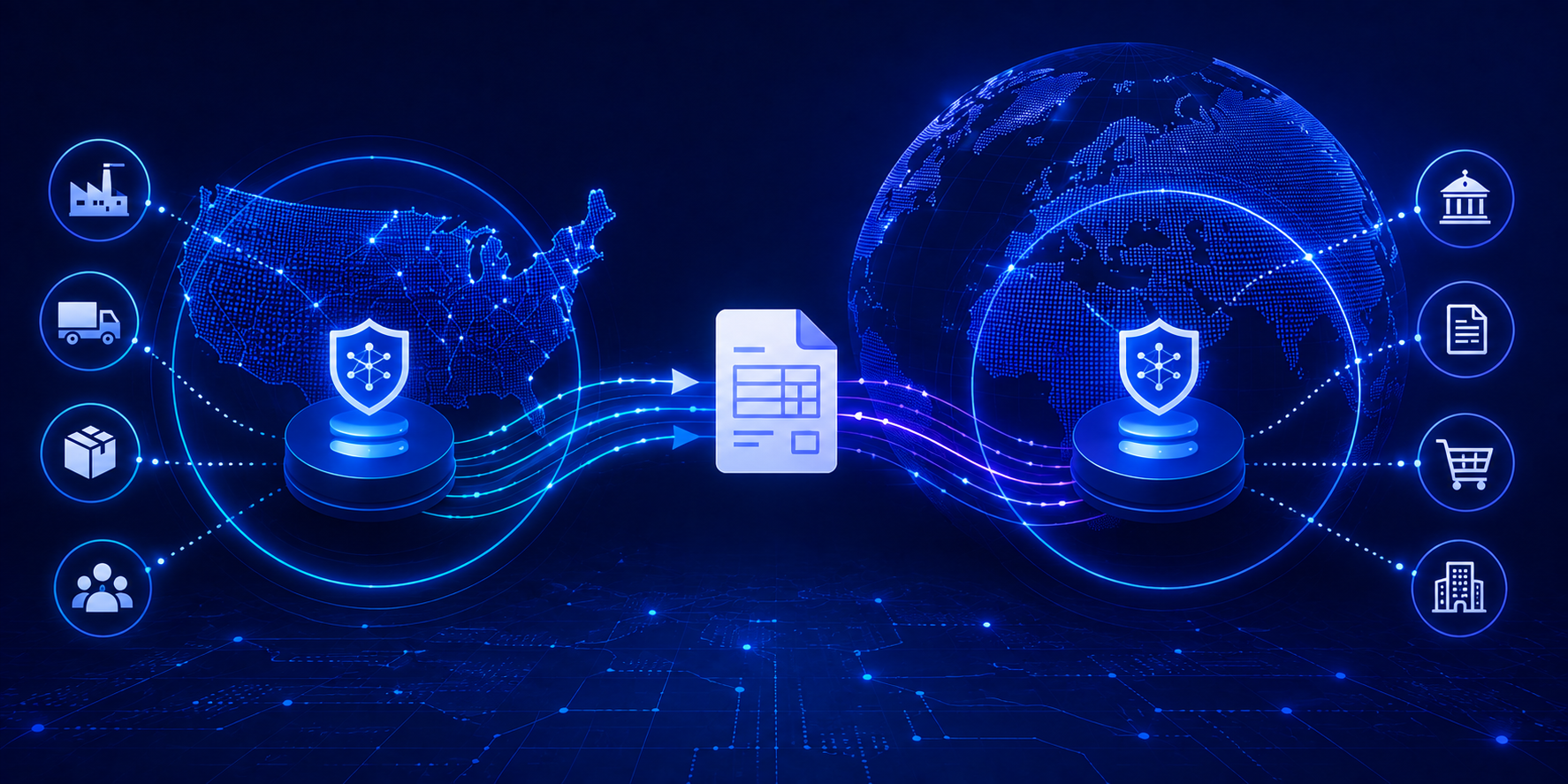
The DBNAlliance runs on a four-corner model: a supplier connects to its own Access Point service provider, which locates and connects to the buyer’s Access Point, which delivers the invoice into the buyer’s AP system. Neither party connects directly to the other or to a government platform. The network uses the OASIS UBL invoice format, AS2/AS4 message transport, and a Service Metadata Locator/Publisher (SML/SMP) system for finding trading partners, on top of digital certificates and an XML validation layer.
That combination, four corners, UBL, SML/SMP, will look immediately familiar to anyone who has worked with Peppol, because it’s built on the same architectural pattern. Some of the DBNAlliance’s own certified providers, including PeppolSoft and Storecove, are established Peppol Access Points in their own right.
DBNAlliance vs. Peppol: How They Compare
| DBNAlliance | Peppol | |
| Origin | Grew out of a 2021 Federal Reserve and Business Payments Coalition initiative | Originated as an EU-funded project (2008–2012), now governed by the nonprofit OpenPeppol association |
| Geographic reach | United States-focused; smaller network, still adding members and certified providers | Active in 30+ countries, with roughly 20 holding their own Peppol Authority |
| Legal status | Voluntary; no U.S. federal mandate requires participation | Mandatory in a growing number of jurisdictions, including Belgium and Croatia as of January 2026, with more tied to the EU’s ViDA reforms |
| Network model | Four-corner exchange via certified Access Points | Four-corner exchange via certified Access Points |
| Governance | Digital Business Networks Alliance (nonprofit) | OpenPeppol (nonprofit association) |
| Standards | OASIS UBL, AS2/AS4 transport, SML/SMP discovery | UBL-based Peppol BIS, EN 16931, AS4 transport, SML/SMP discovery |
| Scale | Growing steadily; enterprise members include Chevron, Microsoft, Halliburton | Established over a decade; reportedly well over a million registered participants worldwide |
As The Invoicing Hub puts it, the two networks share “a common concept, technical architecture, overall philosophy, making them largely identical on a structural level.” Where they genuinely diverge is legal status and scale: Peppol has a decade-plus head start and government mandates behind it in dozens of countries; the DBNAlliance is younger, still voluntary, and still building out its member and provider base.
An Active, Growing Network
The DBNAlliance is a live network that businesses are actively onboarding onto.
Momentum has been particularly visible this year: a first E-Invoicing Conference in New York City in April, an annual members’ meeting scheduled at Microsoft’s Seattle campus in September, and a new Mass Adoption API built specifically to speed up onboarding as the network scales past its early adopters.
Our global e-Invoicing compliance process helps businesses seamlessly meet mandatory e-invoicing and tax clearance mandates, ensuring full regulatory compliance.
What This Means for U.S. Businesses and Their Trading Partners
Because there’s no U.S. federal requirement behind it, DBNAlliance adoption remains a business decision rather than a compliance one. For a domestic-only business, that’s an easy thing to deprioritize. But two groups have real reasons to pay attention now.
The first is any U.S. business already exchanging Peppol invoices with partners in Europe, Australia, New Zealand, or Singapore.
For that group, the DBNAlliance isn’t a new concept to learn, it’s the same four-corner logic applied to domestic trading partners, which shortens the path to getting value from infrastructure they already understand.
The second is any business watching how voluntary networks tend to precede mandates. Peppol itself operated as a voluntary European procurement network for years before individual countries began legislating its use. There’s no indication of a specific U.S. federal e-invoicing mandate on the horizon, but a steadily growing voluntary network is exactly the kind of thing worth tracking rather than assuming away.
Where This Leaves Global E-Invoicing Strategy
From where I sit, running solutions consulting and our partner relationships, the more useful question isn’t “DBNAlliance or Peppol?” It’s how a business stays reachable on both as they continue to grow in parallel. A company with U.S. and international trading partners doesn’t get to pick one network over the other; its suppliers and customers make that choice for it, network by network, depending on where they operate.
That’s precisely the kind of interoperability problem Access Point providers and their partner ecosystems exist to absorb. Tradeshift has operated as a certified Peppol Access Point since 2014 and supports e-invoicing compliance in 70 countries today. Given how closely the DBNAlliance’s architecture mirrors Peppol’s, the interoperability question becomes less about unfamiliar technology and more about network reach, which is exactly the kind of shift we’re tracking as the DBNAlliance’s member and provider base keeps expanding.