

Procure to Pay

Beyond ERP: why you need a dedicated Procure to Pay solution

Traditional ERP systems offer a comprehensive solution for many business functions, but they often fall short when it comes to the intricacies of procure to pay (P2P) processes.

By Lisa Livesley, Account Executive, Tradeshift

The growing pains of mid-market procurement and AP processes

If you work in AP or Procurement at a mid-market or high-growth organization, then you may feel like you’re standing at a crossroads: caught in the middle of a tug-of-war between two contradictory pressures.

On the one hand, you’re required to deal with a rapid increase in the volume and complexity of tasks that cross their desk; on the other, you have to perform this duty faster and at a lower cost.

These impossible demands are made even harder when procurement leads are expected to rely on outdated systems and processes, many of which require a high degree of labour-intensive manual work. 

Procure to Pay (P2P) breakdown – the warning signs

You’ll know there’s a problem when invoices start to get missed, suppliers start to grumble, and cost savings go begging as employees increasingly take matters into their own hands.

Research indicates that around a third (32%) of all businesses say the overall B2B purchasing process is broken.

Meanwhile, a separate study found 84% of mid-market procurement teams have outgrown their ‘homegrown’ processes.

It’s cold comfort to know that you’re in the same leaky boat as your competitors.

A lack of end-to-end procurement capabilities is one of the biggest drags on growth, restricting businesses’ ability to process approvals and payments reliably and quickly.

It also limits visibility into spending and deepens siloes between the procurement and AP departments.

This not only affects areas such as risk management but also denies businesses the insight that’s so central to organisational strategy and growth ambitions.

What are the advantages of a dedicated Procure to Pay platform?

While ERP systems provide a solid foundation for managing various business functions, they often struggle to address the specific needs of procurement.

A dedicated P2P solution can offer several advantages over ERP-based systems, including:

  • Enhanced efficiency: Over 30% of procurement and finance time is spent on manual tasks. P2P platforms use AI to automate workflows, reducing this burden.
  • User-friendly interface: Unlike complex ERPs, P2P platforms feature intuitive interfaces and support punch-out to marketplaces like Amazon Business, simplifying employee purchasing while maintaining control.
  • Global compliance: P2P platforms ensure up-to-date compliance with regional procurement regulations, reducing risk and enabling focus on core operations.
  • Better spend control: P2P solutions provide advanced analytics, real-time insights, and detailed reporting for improved budget management and cost savings.
  • Streamlined collaboration: Modern P2P platforms enhance collaboration between internal teams and external suppliers, replacing inefficient manual processes.
  • Stronger supplier relationships: P2P platforms create ecosystems for buyers and suppliers, enabling real-time data exchange, streamlined invoicing, and centralised supplier management.
  • Scalability: P2P platforms adapt to business growth, integrating seamlessly with ERPs to handle increasing transaction volume and complexity efficiently.

How to run a successful Procure to Pay automation project
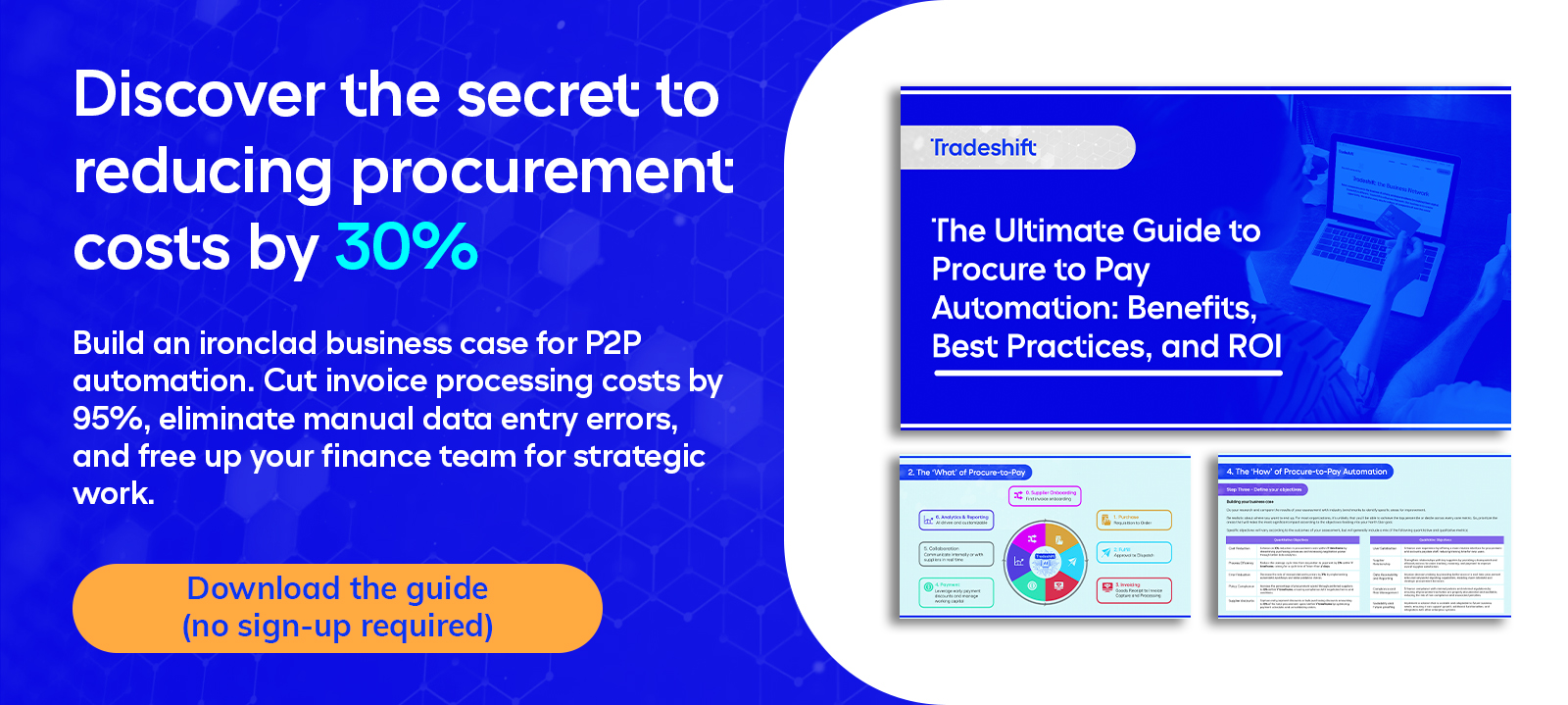
Modular, digital Procure to Pay solutions like Tradeshift are helping mid-sized and high-growth companies unlock new levels of visibility, efficiency, and control in their procurement processes.

Moreover, they deliver a real, rapid, and measurable return on investment, making them a no-brainer for procurement leaders at growing companies.

When implementing a P2P solution, consider the following best practices:

  • Define Your Goals: Clearly articulate your objectives for implementing a P2P solution, such as improving efficiency, reducing costs, or enhancing compliance.
  • Evaluate Vendors: Research and compare different P2P vendors to find the best fit for your organization’s needs.
  • Involve Stakeholders: Ensure that key stakeholders, including procurement, finance, and IT, are involved in the implementation process.
  • Provide Training: Offer comprehensive training to users to maximize adoption and utilization of the P2P solution.
  • Monitor and Optimise: Continuously monitor the performance of the P2P solution and make adjustments as needed.

Tradeshift integrates seamlessly with your ERP to simplify Procure to Pay

Tradeshift Procure to Pay is built for mid-market organisations facing the challenges of growth.

Rising transaction volumes and complex processes demand smarter, more efficient control over spend.

Tradeshift understands these challenges and offers a flexible, scalable, and modular solution to grow with your business.

Our platform simplifies the Procure to Pay process, enhances visibility, and drives compliance across all procurement activities.

Our platform automates every step and integrates seamlessly with your ERP and procurement systems, making modernisation manageable.

Embedded AI automates routine tasks in a controlled environment, lowering costs and delivering ROI faster.

Tradeshift is app-based and includes modular pricing, which means you only pay for what you need. It is a flexible solution that grows with you, giving you control without complexity

Build the solution that’s right for you and scale on your terms. Add features as needed without paying for unused capabilities.
Learn more about Tradeshift’s B2b E Procurement Marketplace

#shifthappens

Procure to Pay

Beyond ERP: Why a Dedicated P2P Solution is Your Procurement’s Missing Piece

By Lisa Livesley, Account Executive, Tradeshift

Traditional ERP systems offer a comprehensive solution for many business functions, but they often fall short when it comes to the intricacies of procure to pay (P2P) processes. In this blog post, we’ll explore why a dedicated procure to pay solution is essential for mid-market organizations seeking to optimize their procurement operations.

The Growing Pains of Mid-Market Procurement

If you work in procurement at a mid-market or high-growth organization, then you may feel like you’re standing at a crossroads: caught in the middle of a tug-of-war between two contradictory pressures. On the one hand, you’re required to deal with a rapid increase in the volume and complexity of tasks that cross their desk; on the other, you have to perform this duty faster and at a lower cost.

These impossible demands are made even harder when procurement leads are expected to rely on outdated systems and processes, many of which require a high degree of labour-intensive manual work. 

Procure to Pay (P2P) breakdown – the warning signs

You’ll know there’s a problem when invoices start to get missed, suppliers start to grumble, and cost savings go begging as employees increasingly take matters into their own hands. If this sounds familiar, you’re not alone. 

Research indicates that around a third (32%) of all businesses say the overall B2B purchasing process is broken. Meanwhile, a separate study found 84% of mid-market procurement teams have outgrown their ‘homegrown’ processes.

It’s cold comfort to know that you’re in the same leaky boat as your competitors. A lack of end-to-end procurement capabilities is one of the biggest drags on growth, restricting businesses’ ability to process approvals and payments reliably and quickly. It also limits visibility into spending and deepens siloes between the procurement and AP departments. This not only affects areas such as risk management but also denies businesses the insight that’s so central to organisational strategy and growth ambitions.

The Advantages of a Dedicated P2P Solution

While ERP systems provide a solid foundation for managing various business functions, they often struggle to address the specific needs of procurement. A dedicated P2P solution can offer several advantages over ERP-based systems, including:


    1. Enhanced Efficiency: Procurement and finance teams spend over 30% of their time on manual tasks. Dedicated P2P platforms streamline procurement and payment workflows using AI to reduce manual work through increased automation.
       
    2. User-Friendly Interface: ERPs can be complex and require extensive training, while dedicated P2P platforms offer intuitive interfaces and even punch-out capabilities to B2B marketplaces like Amazon Business, allowing employees to make purchases while maintaining control.
    3. Global Compliance and Risk Management: ERPs handle general business compliance, but may not cover specific procurement regulations. A dedicated P2P platform ensures compliance across all territories and is regularly updated to meet the latest requirements, allowing companies to focus on delivering products and services without worrying about staying compliant with evolving regulations.
    4. Better Spend Visibility and Control: ERPs track spending but lack detailed insights and real-time data on procurement. Modern P2P platforms offer advanced spend analytics, real-time reporting, and detailed insights into procurement, enabling better budget management and cost-saving opportunities.
    5. Enhanced collaboration functionality: Most ERPs lack collaboration between internal business users and external suppliers, leading to reliance on manual processes like email and spreadsheets. Modern P2P solutions facilitate collaboration between procurement, finance, and accounts payable.
    6. Better Supplier Relationships: ERPs are often inaccessible outside a company’s network, limiting real-time interaction in the procurement process. Advanced procure to pay solutions create ecosystems involving both buyers and suppliers. Platforms like Tradeshift provide a central space for exchanging transactional data, allowing suppliers to manage their products, pricing, and customer support, and issue invoices from a single account.
    7. Scalability and Flexibility: As a business grows, its needs evolve and become more complex. A good P2P platform will scale with your business, adapt to new requirements, and seamlessly integrate with existing ERP systems, ensuring that your procurement processes remain efficient and effective, even as transactions increase in volume and complexity
  • Innovation; ERP vendors have limited focus on each product module and often use outdated platforms. They only add new features for strong business reasons, and there’s no incentive to do so for a small number of customers. In contrast, modern SaaS-based P2P solutions are constantly evolving to meet customer needs, incorporating new technologies like advanced artificial intelligence without legacy baggage.

Implementing a P2P Solution: Best Practices

Modular, digital procure to pay solutions like Tradeshift are helping mid-sized and high-growth companies unlock new levels of visibility, efficiency, and control in their procurement processes. Moreover, they deliver a real, rapid, and measurable return on investment, making them a no-brainer for procurement leaders at growing companies. 

Watch Tradeshift’s mid-market P2P solution in action in this short video

When you’re ready to learn more, get in touch 

Learn more about Tradeshift’s B2b E Procurement Marketplace

#shifthappens