Published on: June 11th, 2026

By Anca Andone
Senior Product Manager
Tradeshift
About the Author
Anca Andone is the Senior Product Manager for Data and Analytics at Tradeshift. She is focusing on supporting the strategic growth in the AI and Innovation areas and on integrating AI tools for operational excellence.
Finance teams have more data than ever, but spotting what matters is still hard
Accounts payable and finance operations generate enormous volumes of data every day: invoices, approvals, document routing decisions, payment transactions. Teams that can extract signal from that noise quickly have a meaningful operational and financial edge.
The problem is that most analytics tools are built to describe what already happened. They tell you what your invoice volumes looked like last quarter, or how long your average approval cycle was. What they don’t do is tell you when something is off before it becomes a costly problem.
That’s exactly where AI-powered anomaly detection comes in. Our Reporting & Analytics app includes anomaly detection that proactively surfaces irregularities in your data, enabling faster decision-making and reducing the risk of undetected issues impacting your business. It’s the difference between reacting to problems after the fact and catching them before they escalate.
✨Our team recently presented the latest agentic AI innovations in Reporting & Analytics at AWS Summit Stockholm. Check out the summary here.
What is the Anomaly Detection dashboard?
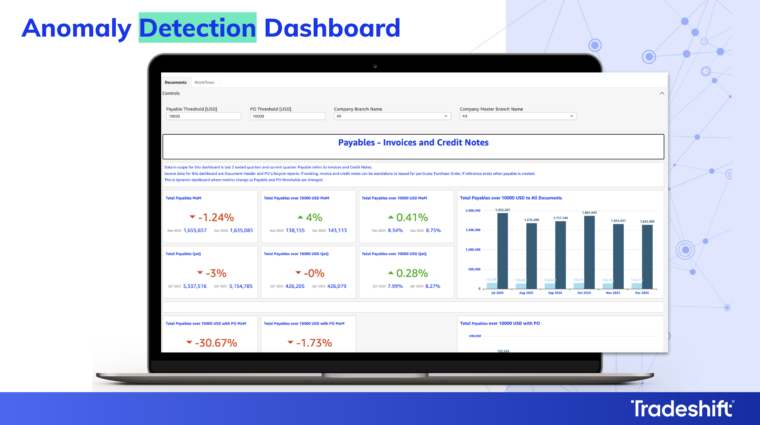
The Anomaly Detection dashboard is an AI-powered capability embedded directly in Tradeshift’s Reporting & Analytics app. It automatically identifies and surfaces data points that deviate from expected patterns across your key AP metrics, so your team can investigate, act, and move on without switching tools or chasing down reports.
This is not a separate module or bolt-on feature. It lives inside the analytics interface your teams already use, which means insights appear where the work happens.
The dashboard focuses on two core areas:
Financial risk and loss prevention.
The dashboard flags high-value documents that fall outside expected thresholds, making it easier to identify and review transactions where there’s a direct risk of financial exposure. This supports early detection of potential fraud, duplicate submissions, or unusual spend patterns before they escalate.
Operational efficiency and behavioral analysis.
Beyond financial risk, the dashboard surfaces anomalies in document workflow behaviour, particularly around approval reassignments. These signals can reveal process bottlenecks, control gaps, or patterns worth investigating from a governance perspective.
Built for the people managing AP, not data scientists
Anomaly detection is seamlessly embedded within your existing dashboards. There are no separate tools, no additional workflows. Insights appear where your teams already work, and your teams don’t need to know how the underlying algorithms work. They just see what’s flagged, why it stands out, and where to look next.
Powered by intelligent algorithms that learn your data patterns, the dashboard surfaces meaningful outliers, not noise. That distinction matters. Alert fatigue is a real problem in finance operations: when everything is flagged, nothing gets acted on. The goal is actionable insights delivered without the noise, so teams can focus on what actually requires attention.
Filters for document value thresholds and company branches let users narrow down what they’re looking at, keeping the focus on what’s relevant to their role and remit.
What can you see in the Anomaly Detection dashboard?
The dashboard analyzes data going back six months, giving your team enough historical context to distinguish genuine anomalies from seasonal variation or one-off events. All data has a 24-hour buffer, consistent with the rest of the Reporting & Analytics app, so what you see reflects your actual operational picture up to the previous day.
From an access perspective, this dashboard is available to all users with access to the Reporting & Analytics app, with no additional setup or separate license required. It is part of the standard embedded reporting available to all buyer master accounts, with one free standard license included per account.
Reducing operational blind spots and protecting revenue
Finance and procurement teams are under increasing pressure to do more with less: process more invoices, catch more exceptions, maintain tighter controls, without proportionally growing headcount. AI-powered anomaly detection directly supports that goal.
By proactively surfacing irregularities, the dashboard reduces operational blind spots and catches costly anomalies before they escalate, protecting revenue, ensuring compliance, and driving proactive business decisions. It enables faster decision-making by reducing the time teams spend manually reviewing large datasets. And not all anomalies are risks: some outliers point to unforeseen opportunities worth exploring.
This is what we mean when we talk about Tradeshift as an AI leader in P2P. It’s not AI for the sake of it. It’s embedded intelligence that does something specific and valuable at the moment teams need it.
👉 Watch this video for a walk-through of Flows with Specialized Research and Anomaly Detection Agents, which deliver days of cross-team work in a single answer. Think of it as just a sample. The capabilities you’ll see can tackle a much broader range of AP challenges and workflows.
From detection to autonomous action
Anomaly detection is one part of a much larger shift underway at Tradeshift. As Raphael Bres, our CPTO, laid out in his 2026 vision for agentic AI, the direction of travel is clear: finance teams will stop managing processes and start managing outcomes. The tools do the execution; people provide judgment on what matters.
Anomaly detection fits directly into that arc. Surfacing irregularities automatically is the first step. What comes next is a set of capabilities that take the loop further.
Reporting & Analytics for Sellers is coming very soon, extending the same data intelligence buyers already rely on to the supplier side of the network. Agentic AI over Analytics will enable agents to not just surface insights but reason across them, run parallel analyses, and return structured findings in plain language, building on the Tradeshift MCP Server that connects Amazon Quick agents to live AP data with full authentication and audit logging.
The AP Auditor Specialist brings a conversational layer to the exact territory anomaly detection already covers: a specialist agent purpose-built for fraud and financial risk, so teams can ask questions and get answers rather than sifting through dashboards. AskAda for Buyers extends conversational AI to AP triage and action, letting teams ask questions about their invoice queue and act directly from the conversation. And Ada 3.0, our Autonomous Resolution capability, will push the automation ceiling higher still, resolving a broader class of exceptions without human intervention.
Each of these moves in the same direction: less time spent on detection and extraction, more time spent on decisions that require human judgment.
Explore Anomaly Detection in the Reporting & Analytics app
The Anomaly Detection dashboard is included in the standard Reporting & Analytics experience for all buyer accounts on Tradeshift, with no additional setup or cost required. If your team is ready to move from reactive reviews to proactive financial management, it’s already there waiting for you.
You may also be interested in
Inside the Tradeshift MCP Server: How We Connected Amazon Quick to Bring Agentic AI to Accounts Payable
How Tradeshift built a secure MCP Server that connects Amazon Quick agents to live AP data with full authentication, RBAC, and audit, turning days of analysis into minutes.
Spring Release ’26: AI-Powered AP Automation & Smarter Reporting
Spring releases have a way of surfacing the work that’s been quietly building in the background. This one is no exception. Our AI-powered AP automation and reporting updates this Spring are some of the most meaningful we’ve shipped, and if your team is still spending time on manual document handling, template maintenance, or chasing down configuration errors, these updates are going to feel like a breath of fresh air.

Autonomous Finance: The 2026 Vision for Agentic AI at Tradeshift
When we first explored the concept of Autonomous Finance, we described it as a fundamental shift in the industry: the moment we moved away from constant human supervision of OCR and RPA toward a system that actually learns from its environment. As we move through 2026, the horizon has shifted once again. We are no longer simply building a platform that processes data efficiently. We are building a network that acts on that data independently, and on your behalf.
Inside the journey: How we brought AI-powered analytics to Tradeshift users
Our legacy analytics tool, Insight Center, had its quirks. It restricted scheduled reports to 25MB, and required manual work to keep data pipelines healthy. But it was familiar, and familiarity breeds trust. So when we introduced the new Reporting & Analytics app with embedded dashboards and reports built in Amazon Quick Suite, even with better performance and design, users were quick to point out differences in numbers. This wasn’t a bug—it was a trust gap.