Published on: May 22nd, 2026

By Raphael Bres
Chief Product & Technology Officer
Tradeshift
About the Author
Raphael Bres is the Chief Product & Technology Officer at Tradeshift, where he leads strategic product innovation and technological transformation across the company’s suite of B2B e-commerce and fintech solutions. With over 25 years of experience in enterprise financial applications and B2B SaaS, Bres has held senior leadership roles at companies including Oracle, Microsoft, Workday, and Certinia.
The age of Agentic AI is here. At Tradeshift, we are developing a network designed to independently leverage data and take action.
When we first explored the concept of Autonomous Finance, we described it as a fundamental shift in the industry: the moment we moved away from constant human supervision of OCR and RPA toward a system that actually learns from its environment.
As we move through 2026, the horizon has shifted once again. We are no longer simply building a platform that processes data efficiently. We are building a network that acts on that data independently, and on your behalf.
Welcome to the era of Agentic AI.
Our 2026 vision at Tradeshift is centered on a single, decisive commitment: doubling down on AI agency on the AWS secured platform. We are evolving from AI that answers questions to AI that executes outcomes. This transition means every user gains a specialized digital assistant capable of navigating the complexity of global trade with minimal human intervention. And it’s not just faster, but fundamentally different.
✨ Our team recently presented the latest agentic AI innovations in Reporting & Analytics at AWS Summit Stockholm.
Building the 2026 AI-Native Ecosystem
To support agentic AI, we started in June 2025 by entirely replatforming our Reporting & Analytics into an in-memory, columnar storage Business Intelligence database built natively on AWS; Amazon Quick. After delivering our production data into new detailed and standard datasets, we leveraged Amazon BedRock AI to run securely over the structured data. In 2026, we strengthened our AI with new autonomous agents on our platform across two core pillars.
1. Agentic AI Analytics and Natural Language
Data trust is the foundation of autonomy. Through AI Reporting & Analytics powered by Amazon Quick, we have embedded GenAI “Q” functionality that enables natural language querying with immediate visual output, making insight accessible to anyone in your organization, not just analysts.
- For Buyers, this means access to 16 dashboards and reports, an Anomaly Detection Dashboard that surfaces risks and inefficiencies the human eye would likely miss, and a Premium tier offering full customization and agentic AI capabilities.
- For Sellers, the vision is equally transformative. The AI Payment Predictor uses historical behavioral patterns to forecast cash flow with precision that manual methods cannot match.
✨ Watch the demo: From insights to actionable intelligence with agentic AI
2. Ada 2.0 and Document Intelligence
The evolution of Ada 2.0 remains central to our roadmap. Leveraging advanced decision-tree algorithms trained on your historical data, Ada has become a highly capable engine for Invoice Auto-coding, making manual entry a genuine relic of the past rather than a recurring cost center. The AI Automation Dashboard provides continuous performance benchmarking, measuring AI efficiency directly against manual processes so you can quantify the impact in real terms.
Combined with AI Document Intelligence, which converts PDF invoices into structured UBL format automatically, we are systematically removing the friction that has defined B2B trade for decades.
The Path to 2026
In 2021, the idea of an autonomous AP platform felt like science fiction. Today, it is table stakes for competitive finance operations. In 2026 and beyond, we believe the distinction between software and agent will become functionally meaningless.
What this means in practice: finance teams will stop managing processes and start managing outcomes, from task automation to goal-driven AI workflow. The agentic layer handles most of the execution; humans provide supervision and judgment on exceptions.
That is a different kind of work, and a more valuable one.
Our Biggest Differentiator: Meaningful, Unique, and Defensible
Tradeshift’s edge is not any single AI capability in isolation. It is the combination of a hybrid AI stack, including Foundation ML, Generative AI, and Agentic AI, running natively on the largest open supplier network in the world. No other AP platform brings these together at this scale.
| Network Scale | AI Stack | Global Compliance | Open Ecosystem |
| $2T+ volume processed | AWS Quick
AWS AI Bedrock |
70 countries | ERP-agnostic architecture |
| 1M+ suppliers connected | Generative AI
AWS – LLM Nova (in-house) |
20 clearance regimes | Babelway iPaaS |
| 80%+ supplier adoption | AWS – Bedrock Agents | Peppol Certified Access Provider since 2014 | Clean-core approach |
This architecture creates a compounding advantage: the Production database, the Reporting & Analytics database, and the AI tooling stack are all running on one secured AWS platform.
That is a structural moat, not just another feature.
What’s Coming in 2026
The roadmap translates this foundation into a new generation of mature agentic capabilities with some items already rolled out:
- AP Auditor Specialist Agent: Agentic AI purpose-built for fraud and risk analysis, with natural language interaction for finance teams
- MCP Chat Agents: Custom agentic workflows that access Tradeshift data cross-platform, enabling AI to act across your existing tool stack
- AP Compliance Expert Agent: Pre-trained AI (RAG) on Compliance and local regulation documentation which assists in reviewing documents according to the mandate requirements
- AI Document Supervisor: A context-aware orchestration agent that spawns specialized extraction agents based on document type and complexity
- Payment Predictor Enhancements: Next-generation ML-based cash flow forecasting with greater precision and scenario modeling
Tradeshift is building Agentic AI designed to take on the operational complexity, manually intensive work that consumes your team’s capacity, so you can redirect that capacity toward the strategic decisions that actually drive growth.
The future of finance is not just autonomous. It is agentic, intelligently actionable, and already in motion.
You may also be interested in
Reporting & Analytics App and our AI vision
Watch our exclusive user webinar to explore our AI vision and capabilities as well as our new Reporting & Analytics app.
Fall 2025 product release: Tradeshift updates for e-Invoicing compliance and AI
The Tradeshift Fall 2025 product release is officially live, bringing with it powerful new e-invoicing compliance features and cutting-edge, AI-powered capabilities designed to benefit both Accounts Payable (AP) and Accounts Receivable (AR) teams. While this article focuses on the key updates, you can find a comprehensive overview of all new features on the Tradeshift platform in our Knowledge Base.

From OCR to autonomous finance: Building an AI-native AP platform
When it comes to AI, we’re way past the theoretical. I remember just a few years ago, in 2021, when we were discussing with businesses about Autonomous AI on the Tradeshift platform, it felt like something out of a distant future. The market just wasn’t ready for it. As a forward-thinking company, our clients often share our mindset. We had some trailblazers who decided to use Ada, our AI coding layer for AP automation, trusting her with up to 99.5% of their processes, even in those early days.
Inside the journey: How we brought AI-powered analytics to Tradeshift users
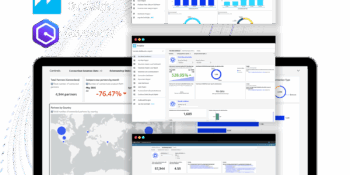
Our legacy analytics tool, Insight Center, had its quirks. It restricted scheduled reports to 25MB, and required manual work to keep data pipelines healthy. But it was familiar, and familiarity breeds trust. So when we introduced the new Reporting & Analytics app with embedded dashboards and reports built in Amazon Quick Suite, even with better performance and design, users were quick to point out differences in numbers. This wasn’t a bug—it was a trust gap.