




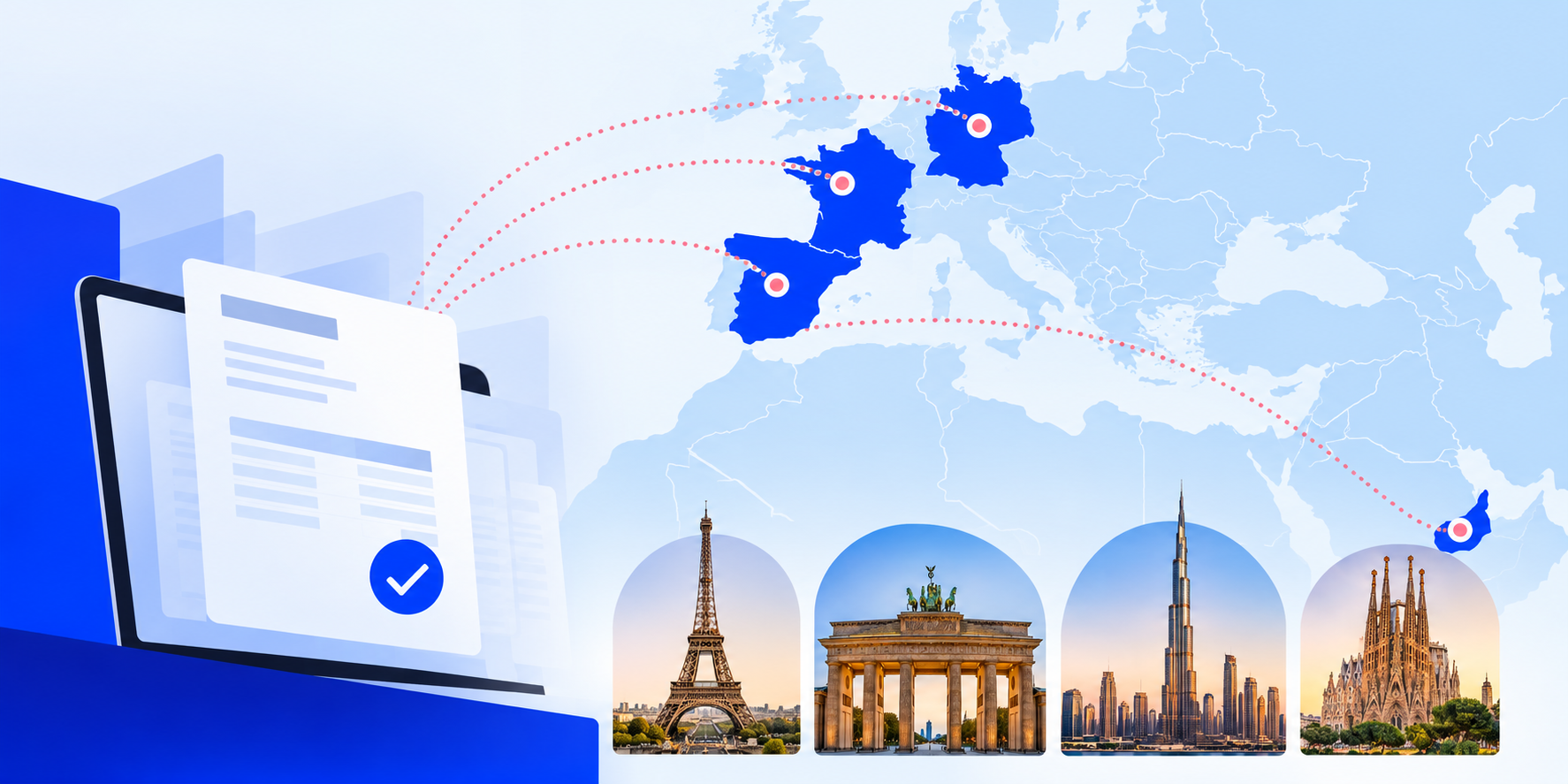
We’re expanding e-invoicing compliance coverage for France, Germany, the UAE, and Spain, and rolling out new capabilities on Babelway.
Our Fall Release webinar is always a good moment to step back and look at the compliance ground we’ve covered since Spring. This season, four markets moved forward at once: France’s Plateforme Agréée mandate went live, Germany’s 2027 deadline came into sharper focus, the UAE’s voluntary phase opened, and Spain published its provisional timetable. We also shipped a set of upgrades on Babelway that our integration heavy customers have been asking for.
It was, as usual for our release webinars, a highly attended and well-rated session. When we asked attendees what to cover next, e-invoicing compliance topped the list. If you registered but missed the live session, or want to watch it again, it’s now available on our on-demand webinar page.
Here’s a recap of what was presented during the webinar and why it matters.
For a full picture of everything in this release, head over to our Release Notes on the Knowledge Base.
France: Live and Processing at Scale
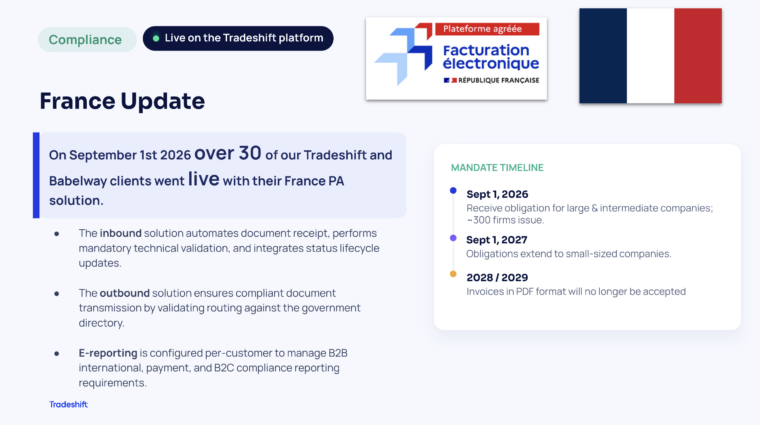
On September 1, 2026, more than 30 Tradeshift and Babelway clients went live with their France Plateforme Agréée solution, right alongside the mandate’s first hard deadline.
On the inbound side, Tradeshift automates document receipt, runs the mandatory technical validation, and keeps status lifecycle updates flowing back to you automatically. On the outbound side, we validate routing against the government directory before anything is transmitted, so documents reach the right recipient the first time. E-reporting is configured per customer, covering B2B international transactions, payment status, and B2C reporting obligations as they apply to your business.
The mandate rolls out in stages: large and intermediate companies took on the receive obligation as of September 1, 2026, with roughly 300 firms issuing e-invoices from day one; small companies join on September 1, 2027; and PDF invoices will stop being accepted entirely in 2028/2029.
What this means for your team:
- Proven at go-live scale: more than 30 customers processing live France PA traffic, not a pilot group
- Inbound and outbound covered: automated receipt, validation, and compliant routing in one flow
- Reporting configured to you: e-reporting rules set per customer for B2B international, payment, and B2C obligations
Germany: The Clock Starts January 2027
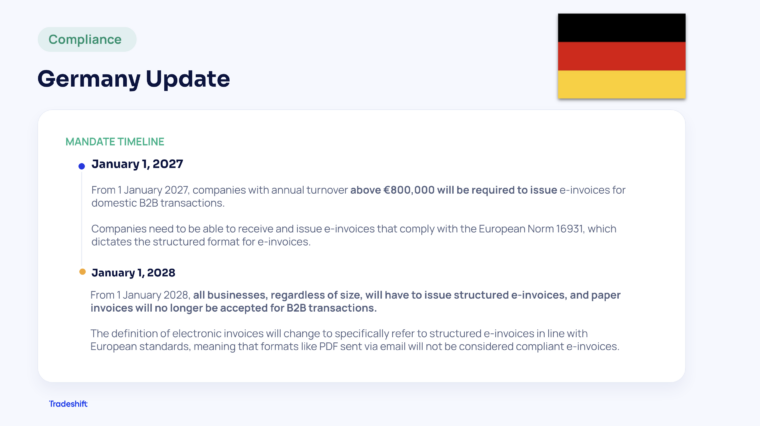
Germany’s e-invoicing mandate takes effect January 1, 2027: companies with annual turnover above €800,000 will be required to issue e-invoices for domestic B2B transactions. Businesses need to be able to receive and issue e-invoices compliant with European Norm 16931, which sets the structured format e-invoices must follow.
A second deadline follows a year later. From January 1, 2028, every business, regardless of size, must issue structured e-invoices, and paper invoices will no longer be accepted for B2B transactions. The definition of an electronic invoice changes too: it will specifically mean a structured e-invoice in line with European standards, so a PDF sent by email will no longer count as compliant.
Germany is one of our fastest growing clearance markets, and outbound e-invoicing support for the German mandate is already on our roadmap ahead of the January 2027 deadline.
What this means for your team:
- Two dates to plan around: the €800,000 turnover threshold in 2027, full B2B coverage in 2028
- EN 16931 by default: the structured formats you’ll need to issue and receive are built to the European standard
- PDF invoices lose their compliant status from 2028, so it’s worth starting the conversation with your AP team now
UAE: Voluntary Phase Open, First Deadline Set for 2027
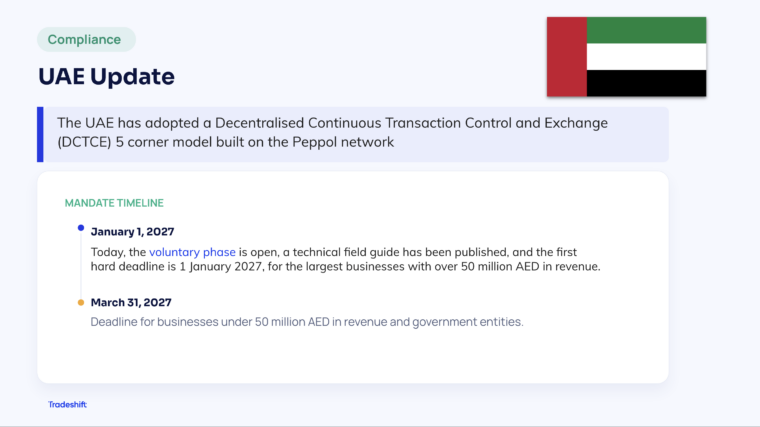
The UAE’s e-invoicing mandate is moving from planning into practice. The voluntary phase is open today, a technical field guide has been published, and the first hard deadline is set for January 1, 2027, for the largest businesses (those with more than 50 million AED in revenue). Businesses under that threshold, along with government entities, have until March 31, 2027.
The UAE has adopted a Decentralised Continuous Transaction Control and Exchange (DCTCE) model, a five-corner structure built on the Peppol network, the same network infrastructure Tradeshift already operates in other markets.
What this means for your team:
- Runway to prepare: the voluntary phase and published field guide give your team time to plan before the first deadline hits
- Familiar infrastructure: the five-corner DCTCE model runs on Peppol, a network we already operate in
- Two deadlines, sized to you: January 2027 for large enterprises, March 2027 for everyone else
Spain: A Provisional Timetable Worth Watching
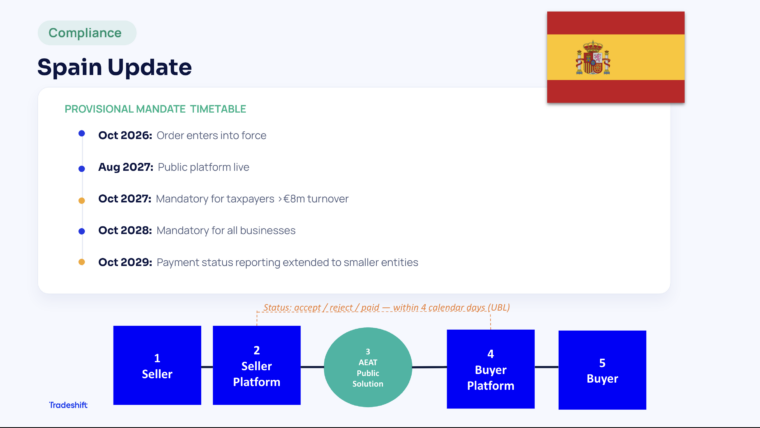
Spain’s mandate timetable is still provisional, but the shape of it is becoming clear. The order is expected to enter into force in October 2026, with the public platform going live in August 2027. Mandatory adoption follows in phases: businesses with turnover above €8 million from October 2027, and all businesses from October 2028. Payment status reporting then extends to smaller entities from October 2029.
The workflow itself runs through five steps: from the seller, to the seller’s platform, to the AEAT public solution, to the buyer’s platform, to the buyer, with status updates (accepted, rejected, or paid) reported in UBL format within four calendar days.
What this means for your team:
- A clear runway, even at draft stage: five confirmed milestones between now and 2029 to plan resourcing around
- Status reporting built in: accept, reject, and paid statuses flow back within four calendar days, in UBL
- One more market, one platform: Spain joins France, Germany, and the UAE on the same Tradeshift compliance infrastructure
Babelway: New Capabilities for Integration Teams
We’ve made a set of enhancements to Babelway this release, all aimed at making the platform more flexible for the teams who live in it every day.
On the Plateforme Agréée side, we’ve rolled out the latest validations, tested them against a full range of scenarios, and added easier end-user functions for enriching content, including support for “Flux 3,” an optional legacy integration path. Babelway remains ISO 27001, SOC 1, SOC 2, and GDPR compliant, a standard we’ve held since 2014.
The XSLT Transformation editor has been rebuilt from a basic text block into a full inline IDE, with suggestions, syntax highlighting, and function documentation available without leaving the platform.
And on the connectivity side, OAuth 2 tokens are now centrally managed, and we’ve added support for AWS S3 integration, so you can push and pull content into your own S3 environment seamlessly.
What this means for your team:
- Fewer surprises going live: expanded validation and testing coverage, plus a legacy path via Flux 3 for connections that need it
- Faster transformation work: the rebuilt XSLT editor brings syntax highlighting and inline documentation into the platform, no extra tooling required
- Easier scaling: centralized OAuth 2 token management reduces the chance of hitting API rate limits as your integrations grow, and native AWS S3 support gives you a direct path to push and pull content
The Bigger Picture
Four markets at four different stages, one platform underneath all of them. That’s the point. Whether you’re already live in France, watching Germany’s clock tick down to January 2027, preparing for the UAE’s first deadline, or keeping an eye on Spain’s provisional timetable, you don’t need a different vendor for each one. We’re building the coverage ahead of the mandates, not reacting to them once they land.
For a full picture of everything in this release, head over to our Release Notes on the Knowledge Base. And if you’d like to watch the full webinar, it’s available on demand here.