



Tradeshift has been named a Leader in the IDC MarketScape for worldwide compliant e-invoicing solutions. Here is how our customers build global compliance one country at a time, and why we believe the value now sits above the compliance layer.
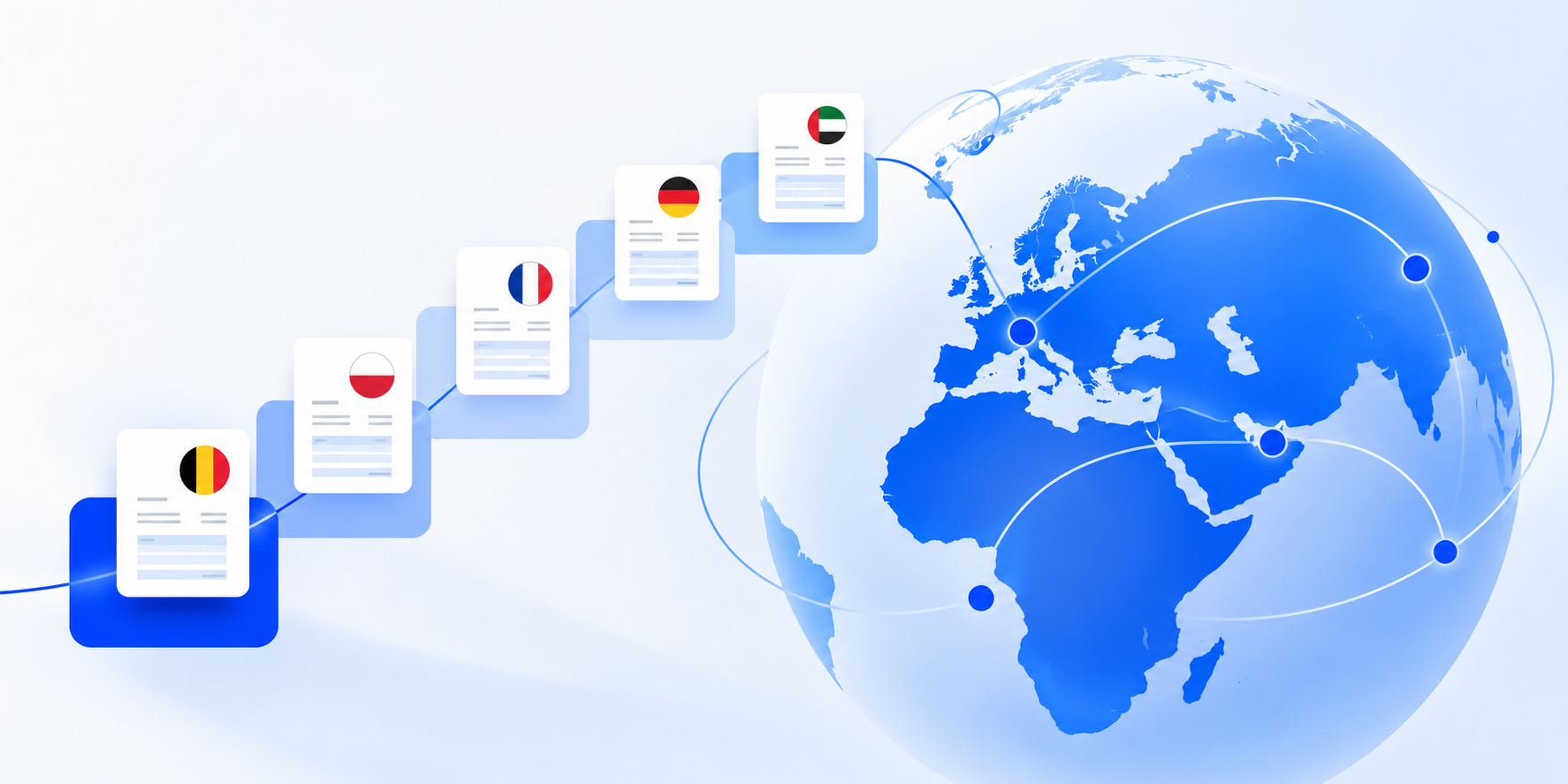
In the space of one year, a multinational with global operations will have gone live with Belgium’s Peppol-based mandate in January, Poland’s KSeF clearance platform in the first half of 2026 and France’s reform on 1 September. Before the year is over, the same team has to be ready for Germany’s issuing obligation on 1 January 2027 and for the UAE, where large businesses must start issuing e-invoices on the same day. Each mandate has its own format, its own exchange model and its own enforcement timeline.
Much of the market answers this complexity with the same pitch: orchestration, one layer that handles every country at once. It sounds like the right answer to a global problem, but it is not how most of our new customers begin. They start with one country, usually the one with the nearest deadline, and grow from there.
That is the context in which I am proud to share that Tradeshift has been named a Leader in the IDC MarketScape: Worldwide Compliant e-Invoicing Solutions 2026 Vendor Assessment (IDC #EUR154882626, September 2026). In this article, I want to explain why we believe starting with one country is the practical route to global compliance, and why the real value now sits above the compliance layer.
Why Our New Customers Start With One Country
A first mandate is rarely a strategic choice. It is a deadline. A finance team facing France’s go-live or Germany’s 2027 obligation needs that one country to work, on time, with its own ERP, its own suppliers and its own invoice scenarios. A programme that tries to design every country up front tends to slow down exactly the project that cannot move.
Starting with one country does not mean building something local. The work done for the first mandate, connecting the ERP, mapping the data, setting validation rules and onboarding suppliers, is the foundation for every country that follows. Once it is in place, adding the next country is mainly a configuration and testing exercise on the same platform, connection and team, not a new compliance project.
| Built once, with your first country | Added with each new country |
| ERP integration and data mapping | The country’s format and validation rules |
| Supplier onboarding and network connections | The connection to the tax authority or exchange network |
| Validation, status messages and exception handling | Testing against that country’s real invoice scenarios |
| AP and AR workflows, archiving and reporting | Local archiving and reporting requirements |
This is also how we think about coverage. Tradeshift supports e-invoicing compliance in more than 70 countries and 20 tax clearance mandates, and we have operated as a certified Peppol Access Point since 2014. That breadth is not something a customer has to buy and implement all at once. It means the next country is ready when the business needs it.
We see this pattern with our customers. More than 40 Tradeshift and Babelway customers went live on our Plateforme Agréée in France on day one. For one global bank, the same approach has grown into 99% straight-through processing across 30 countries, and that platform is now supporting its UAE mandate readiness.
Want an independent view of the worldwide e-invoicing compliance market? Download the IDC MarketScape excerpt
Tradeshift Named a Leader in the IDC MarketScape
In September 2026, IDC published the IDC MarketScape: Worldwide Compliant e-Invoicing Solutions 2026 Vendor Assessment, its evaluation of e-invoicing compliance providers for global enterprises. Tradeshift is positioned in the Leaders Category.
According to the IDC MarketScape, “Tradeshift pairs compliance with a large open supplier network and a no-supplier-fee option.” The report also states: “Tradeshift matches the business field commercial invoice against government-cleared tax documents and flags mismatches, addressing a reconciliation gap that many clearance-only tools leave to the customer.”
We believe both points connect to the approach above. An open supplier network that does not charge suppliers per transaction makes it simpler to bring trading partners along each time a new country goes live. And reconciling the cleared tax document with the commercial invoice is an example of where we think the value of e-invoicing now lies: in what happens after the invoice is compliant.
The excerpt we are sharing includes IDC MarketScape’s opinion on the market, its advice for technology buyers and the full Tradeshift vendor profile. If you are building a shortlist, I would recommend reading the buyer advice section in full.
Value Sits Above the Compliance Layer
A few years ago, the main question buyers asked was whether a provider could cover their countries. That question has not gone away, but it has become the entry ticket. Compliance coverage is now expected. AI, data quality and process intelligence are what lead the agenda.
Data quality comes first, because everything else depends on it. France made this very visible: once the network was live, much of the friction in the market came from documents that did not meet the mandated structure, not from the network itself. Our launch there ran without errors in the invoices we cleared because our platform validates every document against the country’s rules before it leaves, rather than waiting for the tax authority’s system to reject it. A mandate forces structured data. The question is whether that data is clean enough to use.
When it is, AI becomes useful. The same structured invoice that satisfies the tax authority can be coded, matched and checked for anomalies automatically, so that fewer invoices need a person to touch them. That is where we have focused our AI work in production, from invoice coding and document capture to anomaly detection.
Process intelligence is the third layer. With every country running on one platform, finance teams can see what happened to each invoice, where exceptions are building up and how payment performance differs across entities, in one place rather than one report per country. Reconciling cleared and commercial documents is part of the same picture.
Curious what AI in AP and compliance looks like in production? See our 2026 AI capabilities.
Five Questions to Ask Before Choosing a Global E-Invoicing Compliance Provider
Whether you are preparing for your first mandate or your fifth, these are the questions I would put to every finalist.
What does it take to go live in my first country? Ask for a realistic timeline for your nearest deadline, with your ERP and your invoice scenarios, and what is needed from your team to meet it.
What does adding the second country involve? Ask which parts are reused and which are rebuilt. If the answer sounds like a new project, the platform will not scale with you.
Does one integration cover both what I send and what I receive? Mandates increasingly apply to both sides. Inbound validation, status messages and archiving should not need separate tools.
What happens after the invoice is cleared? Ask how the cleared tax document is reconciled with the commercial invoice, and how status messages and exceptions get back into your ERP and your AP team’s workflow.
What does the platform do with the data beyond compliance? Ask which automation, AI and analytics capabilities run in production today on the same compliant data, and which are still on the roadmap.
Where to Start, with 2027 in View
The next twelve months bring Germany and UAE issuance on 1 January 2027, France’s obligations for small and micro-enterprises on 1 September 2027, and new timelines announced almost every quarter. For most global businesses, the right starting point is simply the next hard deadline, on a platform that can take on the following countries without starting over.
Germany is a good example. Companies with turnover above €800,000 must issue EN 16931-compliant e-invoices from 1 January 2027, and every business follows a year later. For a company that has not yet faced a mandate, Germany can be the first country. For one that already runs France, Belgium or Poland on the same platform, it is the next step.
Getting ready for Germany’s 2027 deadline? Read what buyers and sellers need to know.
Download: IDC MarketScape: Worldwide Compliant e-Invoicing Solutions 2026 Vendor Assessment (Excerpt)
Read the IDC MarketScape independent assessment of the worldwide compliant e-invoicing market, including IDC’s opinion on the market, advice for technology buyers and the full Tradeshift vendor profile. Download the excerpt
Talk to Tradeshift About Global E-Invoicing Compliance
If you’re preparing for your next e-invoicing mandate or planning for the 2027 deadlines, let’s talk.